
Forage Quality of Switchgrass
A rustic fodder, better than anything else in tough times!
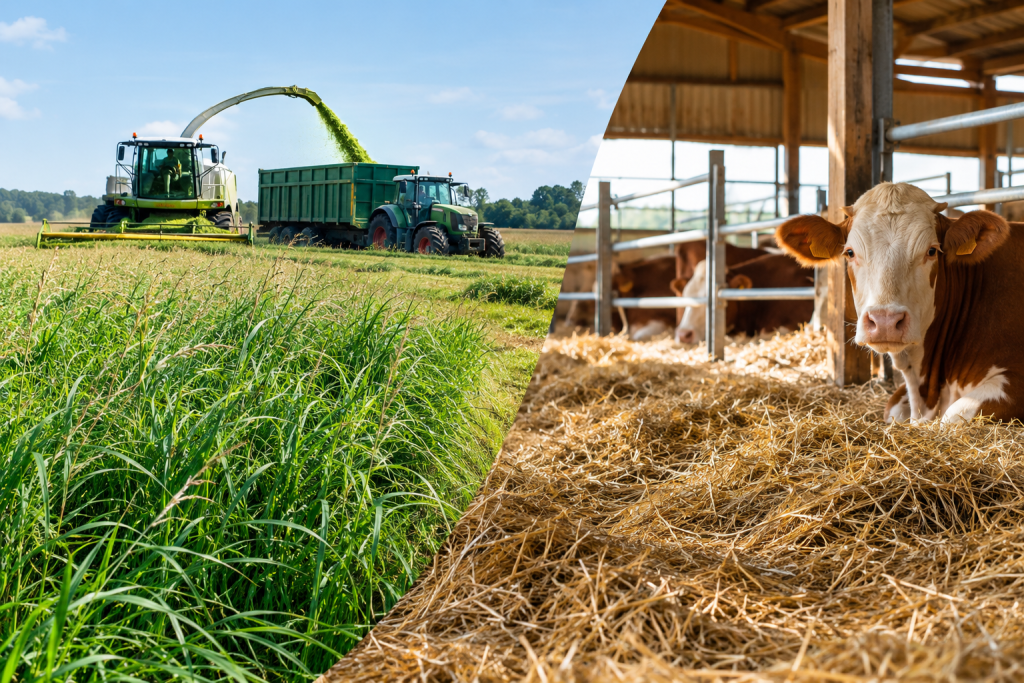
Our analyses conducted between 2007 and 2024 show variable feed quality depending on whether the batches were fertilized or not, and on harvest conditions. Its hardiness, longevity, and versatility make it a valuable forage crop to have on your farm.
- Observed energy value: between 0.58 and 0.83 UFL/kg of dry matter*.
- Digestibility of organic matter: 50.4 to 65.7% based on analyses.
- Total nitrogenous matter (TNM): between 61 and 145.5 g/kg DM; protein content varies greatly with or without fertilization.
- The most favorable results confirm an interesting forage potential; each batch must be evaluated by analysis.
Direct your choice towards forage varieties in mixtures.
This will improve the installation in the first year and then optimize the adaptability of the varieties according to the soil and climate conditions in which they will evolve.
A VERSATILE BIOMASS: silage, haylage, hay, pasture
Forage: to promote batches adapted to the feeding of growing, lactating, dry or maintenance animals, integrating their energy and protein value into the ration.
Alternative bedding: use the biomass harvested at the end of the cycle at maturity for animal bedding.
Comparison of our 4 switchgrass forage test analyses
Key points:
- Switchgrass harvested young has a better nutritional value;
- Switchgrass harvested later is more fibrous and less digestible;
- The effect of nitrogen fertilization improves protein content.
The 4 documents actually contain several harvesting scenarios.
1. Comparison of analyses
The values below are expressed per kilogram of dry matter (DM).
| Analyse | MAT (g/kg MS) | Digestibility MO | UFL | UFV | PDIN |
|---|---|---|---|---|---|
| 1 – 2024 | 80 | 65,7 % | 0,78* | 0,70* | 56 |
| 2 – 2023 | 145,5 | Not specified | 0,74 | 0,66 | 101 |
| 3 – 2007, sample B | 70 | 56,1 % | 0,77 | 0,68 | 81 |
| 3 – 2007, sample C | 61 | 50,4 % | 0,58 | 0,47 | 39 |
| 4 – 2022, without fertilizer | 66 | 59,5 % | 0,68 | 0,59 | 42 |
| 4 – 2022, with fertilizer | 105 | 62,4 % | 0,71 | 0,63 | 68 |
2. Positioning on a forage quality scale
To situate switchgrass, here is an indicative scale of meadow hay quality.
| Very good forage | 0.80 UFL and above | Hay harvested young, good digestibility, suitable for animals with high protein requirements. |
| Good fodder | 0.70 to 0.80 UFL | A valuable forage for cattle, especially as a supplement to a balanced ration. |
| Medium fodder | 0.60 to 0.70 UFL | Suitable for animals with moderate needs, depending on the ration and digestibility. |
| Poor fodder | Less than 0.60 UFL | Generally more fibrous forage, best suited for animals with low needs or for a supplemented ration. |
This scale is a simplified reading grid. Digestibility and bulk values are also important.
Ranking of our analyses
A classification according to UFLs and simple analysis, with reservations related to calculation systems and missing data.
- Analyse 1 – 2024 : switchgrass ensiléGood energy potential
0.83 UFL in SYSTALI 2018 and 65.7% digestibility. The energy value is promising, but the crude protein content of 80 g/kg DM and the protein intake of 56 g/kg DM indicate a moderate protein content.
- Analyse 2 – 2023 : switchgrass vertHigher protein content
With a protein content of 145.5 g/kg DM and a protein content of 101 g/kg DM, this is the protein-rich profile among the analyses provided. However, the absence of digestibility data in the report prevents precise classification based on this criterion.
- Analysis 3 – 2007, Sample BCorrect energy value
0.77 UFL and 56.1% digestibility. The forage has a good energy value, but a crude protein content of 70 g/kg DM.
- Analysis 4 – 2022, switchgrass with fertilizerIntermediate quality
0.71 UFL, 62.4% digestibility and 105 g/kg DM of crude protein. Fertilization significantly improves protein content compared to the unfertilized sample.
- Analysis 4 – 2022, switchgrass without fertilizerlower nutritional value
0.68 UFL, 59.5% digestibility and 66 g/kg DM of crude protein. The protein content is low and the energy value is moderate.
- Analysis 3 – 2007, sample CPoor fodder
0.58 UFL, 0.47 UFV, 50.4% digestibility and 61 g/kg DM of crude protein. This is the least favorable profile of the analyses for use as quality forage.
3. Comparison with conventional meadow hay
Referring back to the indicative values for meadow hay mentioned earlier:
| Criteria | Medium meadow hay | Switchgrass des analyses Seedenergies |
|---|---|---|
| ALONG WITH | 70–100 g/kg MS | 61 to 145.5 g/kg DM |
| UFL | 0,65–0,75 | 0.58 to 0.83* |
| UFV | 0,60–0,70 | 0.47 to 0.76* |
| Digestibility | 55–65 % | 50.4 to 65.7% |
*The extremes include analyses of different dates, harvest conditions and systems. They do not represent an average switchgrass production.
In conclusion, here’s what we can take away from these analyses:
- Switchgrass can achieve an energy value comparable to good meadow hay. This quality is easily improved with appropriate fertilization and harvest timing.
- The weakest analyses show that it can also produce fodder of limited quality, especially if the harvest is late or if the plant is poorly fertilized.
- Its protein content is highly variable: it can be low, but it can also reach a significant level.
- Its quality depends heavily on cultivation practices and the stage of harvest.
4. Key points to remember
- Switchgrass harvested young
The most favorable analyses show that it can provide an energy value comparable to good quality meadow hay.
- Switchgrass harvested later
The observed decrease in digestibility and energy value suggests that a harvest adapted to the needs of livestock farming should be favoured.
This profile may still be suitable for animals with moderate needs such as dry cows, etc…
- Switchgrass for bedding and other uses
When the food quality is lower, the biomass can still be of interest for bedding, cover or other uses.